



King captures: why shortcuts in calculation can mislead
In international draughts, seeing an open diagonal is not enough to judge a capture. You must also remember the pieces that have already been jumped.
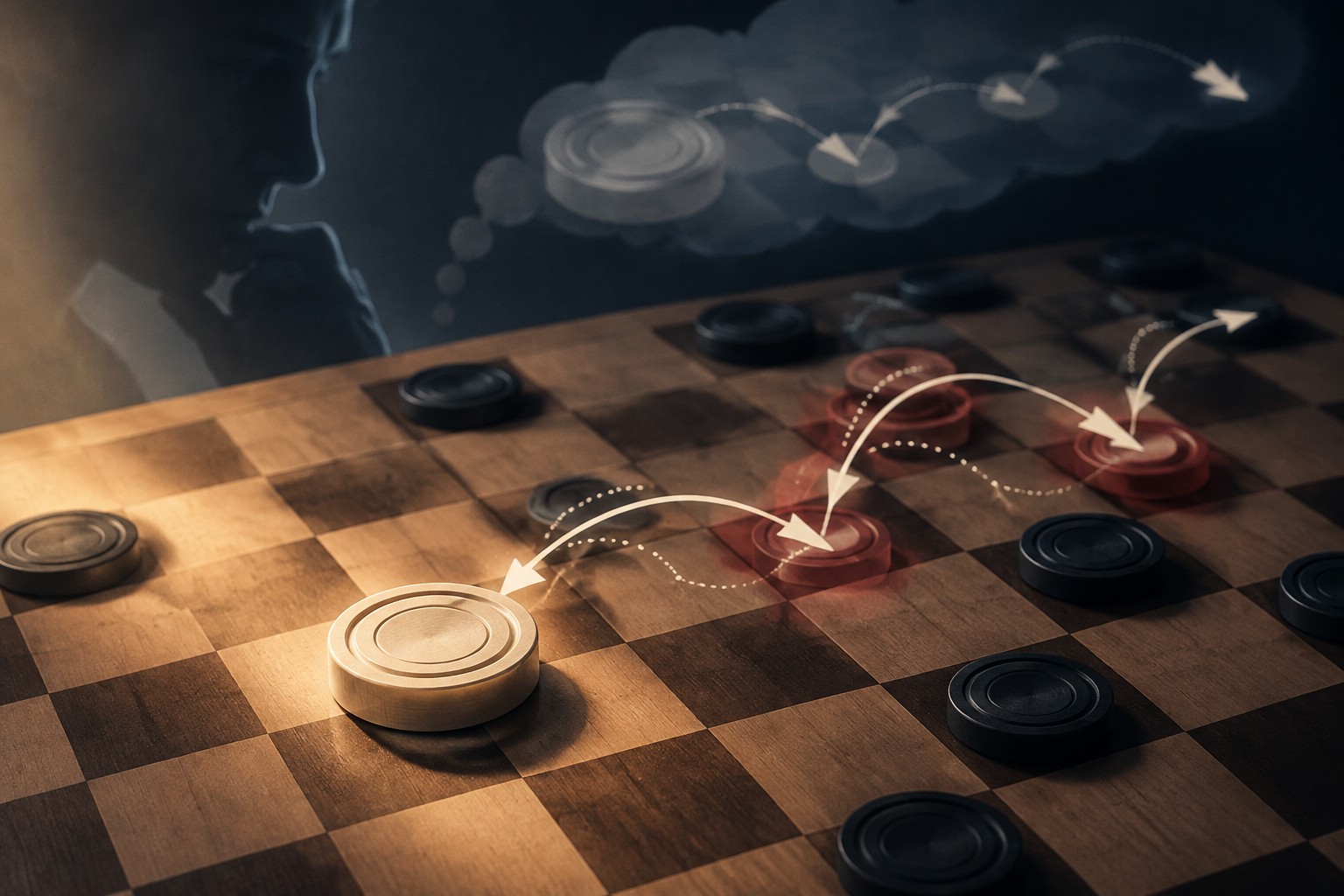
A king begins a capture, changes direction and suddenly appears able to take even more pieces. In your imagination, the board empties quickly. This is precisely when it is easy to simplify the position too soon and calculate a route that is not actually permitted.
International rules contain an important restriction: the same piece cannot be jumped again within a capturing move. Captured pieces also remain on the board until the entire move is finished. Calculation must therefore distinguish between knowing which pieces have been captured and remembering their physical presence along the king’s route.
Another important rule concerns choosing a capture that takes the greatest number of pieces. Before comparing routes, you must establish which ones are legal. An impressive-looking path is not valid simply because it appears to lead through more opposing pieces. Jumping the same piece again cannot be used to extend the move.
During individual study, it helps to pause after each stage of a variation. Where has the king travelled? Which piece has already been jumped? Does the next change of direction attempt to use that piece again? Only after checking these points does it make sense to compare the number of pieces captured.
When practising on a physical board, first trace the entire route without removing captured pieces. Then return to the starting position and calculate it in your head. If the two pictures differ, look for the moment when an obstacle was overlooked. Getting the final count right does not necessarily mean that every restriction was remembered.
Knowing a rule and applying it during a game are different tasks. It is easy to repeat the restriction on jumping the same piece again. It is harder to keep it in mind while a king changes direction several times. Careful calculation starts by retaining the full picture of the move rather than prematurely removing inconvenient obstacles from it.